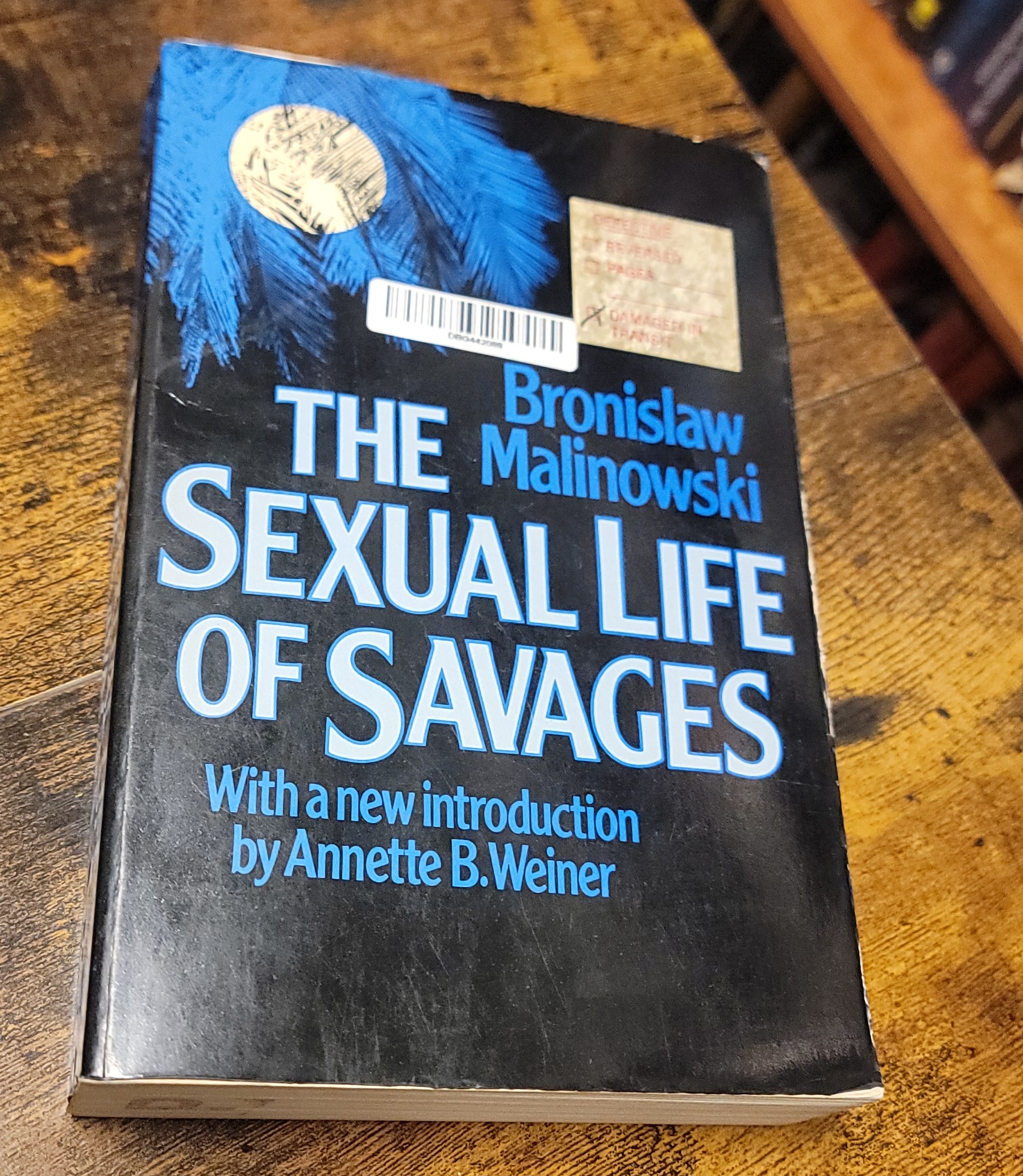
A kin and Caliber reading of Malinowski’s Sexual Life of Savages.
I recently finished Bronislaw Malinowski’s The Sexual Life of Savages, a triggering title that is nonetheless far more readable (and less insulting) than most modern anthropology. Malinowski spent two years living among the Trobriand islanders, who are just off the coast of New Guinea, and did an in-depth study of their customs particularly related to sex and marriage. It’s sometimes titilating but the author always urges readers not to come away with the wrong impressions. He was simply stating that the Trobrianders do what most Europeans did at the time as well.
For my purposes, the most interesting part of this book was that the Trobrianders are matrilineal (meaning the bloodline only goes through the mother, and in fact they seem to be ambivalent about whether the father has any real role in procreation, except that he “makes the way” for a spirit to enter his wife as a fetus), exogamous (meaning they can only marry OUTSIDE of their sub-clan), and patrilocal (meaning when they marry, the wife moves to the husband’s home and village). There are many implications here regarding violence.
- Because women are always crossing into other tribes, the tribes are bound by a network of marriages that act as a brake against rampant warfare. This mesh network of alliances also comes to each other’s aid during warfare.
- If a woman is wronged by her husband, he can expect that her kin (who likely live in a nearby village) will avenge her. Many (perhaps most) intertribal warfare concerns marriage drama. Divorces are common, though.
- The married couple is paid an income by the wife’s blood kin (primarily her brothers), mostly in the form of yams and some other goods, which are the chief forms of inheritance. The yam stores are treasured and put on public display as a symbol of one’s rank. By that logic, the husband in a marriage does not give his biological children his inheritance (of yams, spears, and whatever) but rather transports them to his sister(s) in the nearby village(s). Malinowski doesn’t mention this in the book, but Gemini claims that a Trobriand man’s home, on his and his wife’s death, is broken down and transported to his sister, wherever she may live. This confirms my hypothesis that matrilineal descent is a dis-incenti ve against making large structures, since his sister(s) will demand such structures as inheritance.
- Only chiefs really get away with polygamy, and they marry many women from various tribes, which further enmesh his village into a network of connected villages that come to each other’s aid during war, famine, etc.
- Of particular interest is that chiefs are the only ones who pass their inheritance on to their biological children. Chiefs, therefore, are the only Trobrianders who are incentivized to build an estate, which need not be broken down and moved. Instead, his sons will remain there, dividing it up as needed (Confucian style), and continue to build a small fortified city in each village. This is effectively a transition to patrilineal descent (PLD). This confirms my second hypothesis that a city can’t arise until PLD arises, which it usually does within the ruling or chiefly class, and one of the first major structures to arise is a temple. This appears to have happend in Shang Dynasty China, where only the ruling families could create such estates and temples, and which became centers of commerce and worship (one in the same back then).
Further, as the PLD structure of the temple-city brings in more people under the protection of the deity, the PLD network expands at the expense of the MLD network, as in Rome, Tenochtitlan, and other ancient cities.
Overall, a lovely book. I could go on at length about all the other interesting things that happen in Trobriand society. For its time it’s remarkably liberal in its depiction of the people as being no different from Europeans in underlying beliefs and mores, which simply express themselves in different ways. It’s also very easy to read for the layperson, though I find anthropology before World War I1 to always be this way. Postwar anthropology borders on unreadable and turned anthropology into a “specialty”, but this book recalls a time when anthropology was for everyone.
Leave a Reply