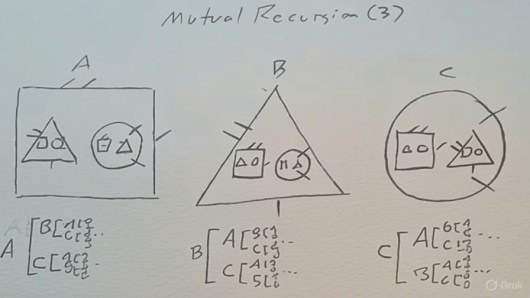
Steven Pinker was recently on EconTalk with Russ Roberts, who (shameless plug) featured me some years ago and urged me to write my book. Thanks Russ. Pinker tackles the problem of how humans acquire cultural knowledge, which he describes as an infinite regression (recursion) of beliefs.
A quick summary: at 1:51 Pinker describes the Finite Skull Problem, where there are infinite nested thoughts in the mind, which technically can’t fit into a finite skull. At 2:35 he posits a more efficient psychological mechanism as a solution whereby one relies more on the sense that something is “public or salient or self-evident or out there.” At 8:10 he describes conspicuity which is the mutual observation which solves the problem of coordination without needing the infinite recursive process.
Steven Pinker’s book The Language Instinct (1995, 2000 edition cited) is essentially a rebuttal to Chomsky’s claim that there was no way for recursion to have evolved gradually, rather appearing suddenly in the human brain, like a Big Bang of language. Pinker instead hypothesizes that as humans evolved away from our primate ancestors, recursive language evolved so we could communicate better. This came about via everyday natural selection:
The language instinct, like the eye, is an example of what Darwin called “‘that perfection of structure and co-adaptation which justly excites our admiration,” and as such it bears the unmistakable stamp of nature’s designer, natural selection (373).
Baked into this argument is the common assumption that early humans were only able to make universally similar handaxes if we had language:
Homo erectus, which spread from Africa across much of the old world from 1.5 million to 500,000 years ago (all the way to China and Indonesia), controlled fire and almost everywhere used the same symmetrical, well-crafted stone hand-axes. It is easy to imagine some form of language contributing to such successes, though again we cannot be sure (363).
Notwithstanding my claim that stone hand-axes appear not to be tools at all but are more likely early language themselves, this argument has the same two issues that every gradualist, Darwinist theory of origin faces: 1) how did this happen only once, and 2) how do we know we’re all that different from animals? A fair share of The Language Instinct is dedicated to differentiating humans from animals, particularly in reference to recursion, but studies have emerged since which also report recursion in crows, orangutans, and carnivores in general.
So, perhaps it’s assumed that only in humans does recursion affect our communication, yet we can also ask, Why not assume these animals also communicate recursively, which is beyond our comprehension? Why not trees and mushrooms? Why not the earth? Since we can’t go into a non-human brain to experience recursion as they do, there are simply no good answers to this.
What’s missing from the recursion research is a concrete differentiating factor between humans and animals (and everything else). So far, no such factor has been found. This is by design: the assumption is that humans gradually evolved from an ancient primate, so there can technically be no concrete difference between us and them. It can only be a blurry data point on a spectrum of adaptations, always with something preceding and following it. And still, we can’t figure out why no such data point appears in any current animals. Why no animals are crossing the Rubicon of hominization, no matter how much sign language we throw at them.
My proposal to end this debate is to bring up the one kind of recursion that can’t exist among animals: reciprocal, object-based aggression (ROBA). The capacity to wield wildcard objects in combat, and the ability to anticipate the same in everyone else, is an exclusive and universal human trait. Unlike animals which can anticipate the weapon in combat, we are not so certain; and we know our opponent is uncertain.
So, ROBA is recursion itself. This creates the model for a self-referential recursion like we see in computer programming and sentence parsing:

More, ROBA is mutually recursive: one anticipates one’s enemy anticipating oneself forever. This is the same framework as the dialog: one anticipates the interlocutor’s anticipation of the self’s anticipation… only not of weapons, but of symbols.

This is not all. Everyone anticipates everyone anticipating everyone to the power of 8 billion. This fractalizes to frighting degrees even when there are only three present:

Recursion is an inadequate term. Self-reference isn’t enough. Omni-reference is the infinite, mind-dizzying reality Pinker is describing. I’ve proposed a better term for this: recursia.
ROBA is only one form of recursia. So are language, religion, and culture overall, but animalitarians might claim these are present in animals. Yet ROBA is definitely not in animals, although we seem to be under some strange delusion that animals even have this:
My book If These Fists Could Talk debunks this myth and proposes this extremely simple explanation to the recursion problem: ROBA, language, and all of our culture are products of recursia, which is the exclusive human property. I don’t deal with where it came from, since that’s beyond my hypothesis. I merely claim that violence and culture are uniquely intertwined human traits. To understand one, study the other. Our Better Angels can easily be nested into The Language Instinct under this model, since they stem from the same plumbing.
I’d love if you read the book and checked my work. You can get it at the link below on Amazon:
