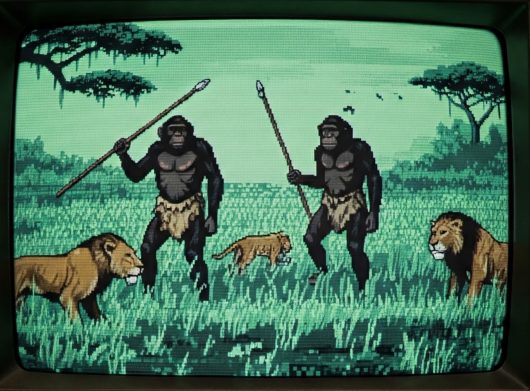
The Myth of the Weaponized Ape

With my book If These Fists Could Talk coming out this month, I’m starting research for my next book on the mythology of violence.

We have a story we tell in our science: that as primates left the jungles of Africa, they underwent the trials of the environment, which evolved their component parts – brains, communication capacity, group size, aggression – until they became hominins. Agricultural societies, especially the Aryan ones, all tend to share in myths that the gods were essentially those of the weather. In Iran, Marduk the sun god beats Tiamat the dragon. In almost all originary myths, the dragon is associated with water; it’s the Nile crocodile, which devours humans and cattle, prohibiting the crossing of water. The Great Yu in China is remembered as establishing “the flood plan”, creating an irrigation system to resolve flooding. So, the sun beats the floods. This is recorded as gods competing over control of the weather.

In essence, Aryan mythology appears to be primarily a mythology of agriculture. Gods of technology and domestication factor into the agricultural process. There are gods of war, like the Iranian Mithra and Indian Indra, but these are more like mascots or champions. There is no “founder” of war or violence itself; rather, there is a patron god who helps his or her people win wars, or engage in incessant warfare in the heavens. There are often gods of metals too, which factor into these wars.

I would challenge scientists to think more concretely about their own cosmogonies (theories of origin). Do they descend from agricultural myths which claim that humans were fashioned by the environment? Because such a belief completely obscures the origin of violence. There is now a Mandela Effect where people (and all the AI I’ve interacted with) think that chimpanzees fight with clubs and rocks.

When pressed, they realize that the “weaponized ape” is utter mythology. It’s a convenient mythology – it justifies the belief that our aggression only differs in degree, not in kind – but it is a mythology nonetheless.

There are older myths which appear to predate the agricultural myths. Often these are totemic myths of origin. There are often myths of the origin of fire, hunting, etc. But again, I’ve yet to see an origin of violence. It’s shocking to think that even the oldest myths could conceptualize the origin of humanity, but not our violence. It really has been a blind spot forever.

My book If These Fists Could Talk releases January 2025, be sure to get it at Amazon. Your purchase will help fund my continued research.

Also I welcome anyone who would like to have a friendly debate on violence, evolution, anthropology, mythology, or any related topic. We can set a time and date, record it live, and release it on my channel.

8 responses to “The Myth of the Weaponized Ape”

  1. […] of human networks and fall prey to the myth of the kinless caveman, which is part and parcel to the myth of the weaponized ape. Both descend from a theory that humans are just animals, that kinship and religion are options in […]

  2. […] previously delved into two myths presented by the standard model of evolutionary science: the myth of the weaponized ape, and the myth of the kinless caveman. These myths are totally without any kind of anthropoligical […]

  3. […] into bonobos and chimpanzees, chimps still “pointing” to ROBA through the use of object-based intimidation and bonobos still reproducing like humans. (I don’t necessarily believe this, but it fits the […]

  4. Chris Avatar
    Chris

    I can think of one mythological story that deals with the origin of human violence and fits perfectly with the ROBA hypothesis: 2001 A Space Odyssey. Of course not ancient, but damn does it fit. Under the transformative influence of the black monolith, an ape for the first time uses a weapon to kill another ape and thus humanity is born. It puts “human violence” as you would call it as the explicit origin of humanity, the point that human history begins. I think a lot of people identify that act in the film as just “the first tool use”, but after reading some of your blog here it seems obviously notable that it’s a *weapon*, not just a “tool.”

    1. Eric Jacobus Avatar
      Eric Jacobus

      Kubrick was close, he was reading Ardrey at the time, who hypothesized that as humans hunted in bigger groups and used more complex tools for hunts, we eventually turned those on each other. This has, shockingly, been the same stance of military historians ever since. I have a major problem with the idea that humans evolved out of utilitarian animals. It makes religion seem optional (since many evolutionary theorists claim to be non-religious, as though they are going back to the utilitarian cave man), and it crafts this myth of cavemen without large communities, when without a doubt they lived in complex kinship groups with incest taboos. And it doesn’t bridge the gap between animal combat, which uses no tools (even when tools can be used in hunting or sustenance), and human combat, which can use literally anything.

  5. […] This is surprising because of the primate’s capacity to mimic tool-usage, but only in sustenance—cracking nuts with stones, or the Japanese macaque washing potatoes—and predation—chimps licking a sticks to fish for termites. Gibson and Ingold’s Tools, Language and Cognition in Human Evolution is chock full of examples of primates teaching tool-based skills, but none of it is ever recorded as being used in combat, except for, again, false memories of the Gombe war. I even debated Google’s Gemini on this, and it made the same mistake. (If you need more convincing, read my article The Myth of the Weaponized Ape.) […]

  6. […] on Violence (available here on Amazon), I formulate the ROBA Hypothesis on human violence. Whereas animal combat uses only their natural weapons, human combat is capable of using any object—a trait I call reciprocal, object-based aggression […]

  7. […] Animals are firewalled from this, being forced to use their natural weapons during combat, even if they can use tools for everything else. However, humans have ROBA, meaning we lack no such […]

Leave a Reply

This site uses Akismet to reduce spam. Learn how your comment data is processed.

Discover more from Eric Jacobus

Subscribe now to keep reading and get access to the full archive.

Continue reading