Reportedly, an adult star named Lily Phillips slept with 100 men and, surprise, is pregnant!
This was once called “temple prostitution.” A woman would sell herself (or be sold) to a temple & “serve the god” as his seed bank. Anon. men would come and pay, sometimes dress up as the god, do their thing and leave. The child was born to a “virgin” and was a “son of god.”
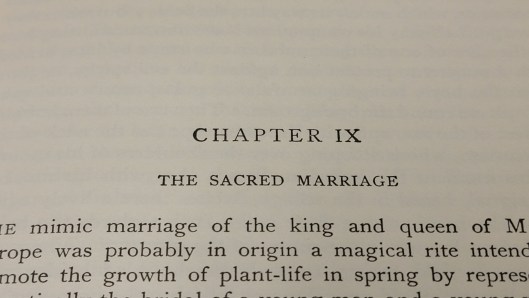
Chapter 9 of the Aftermath volume of James Frazer’s Golden Bough is the “Sacred Marriage.” Examples include a Bengali girl married to Juggernaut, whereby a brahmin enters through the back door, “enjoys” the girl, tells her things, which she believes is coming from the mouth of Juggernaut, and she imparts the wisdom she learned to the village (pp 160-161).

Full disclosure: I take what Frazer says in this series with a grain of salt. I’m aware that he rarely did any field work of his own, most of the info in The Golden Bough being pulled from other sources. However, 1) many of those sources have reliable data, no matter their conclusions which were definitely “of their time”, and 2) Frazer’s data helps make sense of what have previously been baffling myths such as those of “virgin births” and dragons.

Among the Baganda of Africa, Nende, the god of war, had 6 wives who never left the sacred enclosure (161). At a south Nigerian shrine women aspired to be diviners or prophetesses, and these women are high status and wedded to the water serpent, who comes out every 8th day, during which she sacrifices to it (162).

Some sacred marriages were for life, as in the Nyasa region where the women were married to a snake-lion (162).

Then Frazer gets into the fun stuff: human sacrifice! In French Sudan, at Bamaka, they threw a virgin into the Niger river as a sacrifice to the crocodile god.

So with China, where human victims were once drowned in the Yellow River to the god, who was a man with a fish head riding on dragons, and Emperor Tsin in 417 BC would float a “bride” from his family to the river god and let her drown, making him kin with the river god. Wen de Wei (427-387 BC) reportedly abolished this.


Three conclusions:
1) Temple prostitution was not prostitution as we know it today; it served a sacred function whereby the temple (and its priests/priestesses and god(s)) could claim a child as its heir without any competing claims made by the “bride’s” family. Similarly, Lily Phillips is sleeping with 100 men so that no one man can claim ownership over this heir. The child, per ancient kinship, is technically born of a “virgin” simply because she is his/her only known kin.
2) I suspect that the Nephilim of Genesis 6, the supposed gods or demons or what have you, who came down and bedded the earthling women, were just foreign men who slept with temple prostitutes. Their children were similarly “sons of Elohim,” children of temple prostitutes who were dedicated to gods and/or priests. Often such children are considered monsters or “half-breeds.” Minotaurs and other such abominations are most likely not psychological constructs but kinship terms for illegitimate children sired by foreign totems represented by animals.
3) Sacrifices to crocodiles and alligators were probably the origins of most, if not all, dragon myths. The sacred marriage here was separate from that of the temple and involved no prostitution, and yet the outcome was the same. The god thereby received an heir (and the crocodile a meal to hold itself over while the herders could transport their herds across the ford). Dragons are almost invariably water serpents, even if they spew fire, and they tend to be “retainers” of princesses. The European myth of the hero saving the princess from the dragon is not a psychological or symbolic tale of “facing one’s fears” but an update on this kinship system. The introduction of bridges over waterways negated the need to throw sacrifices to water dragons/crocodiles, and so the hero could be recast as a valiant warrior who reclaims the woman for his own kin line. The Jungian interpretation by the likes of @jordanbpeterson was a much later gloss.
Kinship is everywhere and everything at the origin of society. I discuss kinship and its relationship with violence in my book If These Fists Could Talk: A Stuntman’s Unflinching Take on Violence, which you can grab on Amazon in paperback or eBook format. Give it a read, and please leave a review!


Leave a Reply