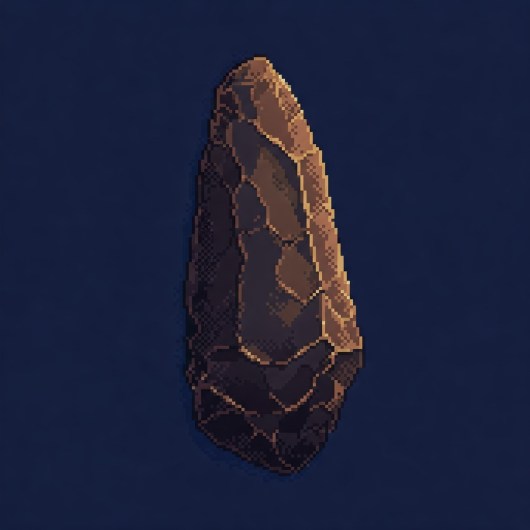
I’ve written previously about how ancient handaxes might have originally been modified stones for the purpose of exchange, not for utility. If reciprocal, object-based aggression (ROBA) is the base system of human combat, then every stone is a potential weapon, every person a potential combatant, and the entire world a potential graveyard.
The original act of uniquely human aggression, if one could ever be hypothesized, would the act of stoning. It seems unlikely that the first murder could have been an act of spear strikes. This would require the technology of fire-sharpened sticks. Stones are weaponizable before fire. They’re just sitting around, ready to go.
Why would someone have been stoned to death back then? We can hypothesize various crimes, religious or not, like theft, lying, killing, etc., but from all the ethnographic literature I’ve read, there is only one universal law of ancient society: incest is punishable by death. There seems to be no exception to this in the most ancient of societies. Particularly illuminating are the Navajo “chantway” myths, which are horror stories about siblings who are married by a family matchmaker to prevent the family from being contaminated by an outsider, but the siblings go mad and dash themselves into the fire. The Girardian in my says, “Yeah right. They were burned at the stake.”
By incest, we simply mean “violation of marriage laws.” In matrilineal society, one is forbidden to marry one’s “sibling,” “parent,” or other such clan member. But these terms mean different things in ancient society, where they are “classificatory,” than in our society, where they are “biological.” One’s biological sixth cousin might be marriageable in modern society, but in a hardcore matrilineal network, if she has the same clan marker and is of the same generation, she is one’s “sister” and unmarraigeable. All things equal, marrying her is punishable by death. By contrast, one’s biological “father” is unquestionably unmarriageable in all modern society, but in the most ancient of matrilineal societies, he has a different clan marker than his daughter, and they might be marriageable. Unthinkable to our modern sentiments, yes, but these things must be thought if we want a real science of the human. (For the sake of brevity I won’t get into royal incestuous unions, such as in Egyptian lineages. There is too much to unpack there, and I don’t even necessarily trust the record; it’s possible such schemes were incestuous only on paper. In reading about the Ptolemaic dynasty, a line of Greek usurpers who adopted the incestuous marriage as a token, I find the idea ridiculous and, at least in that case, it might have been only a ruse. A marriageable partner could easily be adopted and then married “incestuously” to conform to Egyptian tradition. At any rate, the goal was not to “keep the line pure” but rather to allow for the stockpiling of resources, an impossible act in a traditional matrilocal marriage.)
Some tribes of Australian Aborigines would subject incestuous couples to the ordeal of the spears, either with the male given a small shield to defend himself, or the couple forced through a gauntlet of spear-throwers. If they live, they are exiled. The goal seems to be a cleansing of the community, who can at least say, “Well, we tried. It’s not our problem anymore. Let the gods have them now.” A couple thus cut off might survive two generations on the coast, but they would not survive central Australia. You were good as dead if you committed incest, and that was adequate for them.
It’s at least feasible that the first perceived crime was that of incest. We have to really bend over backwards to understand why, being as indoctrinated as we are into modern synthesis. The term “incest” conjures thoughts of European royal families, American hillbillies, and middle Eastern bumpkins, all of whom we imagine to be subject to reduced IQ or other maladies that would have “naturally” led to laws against incest. But such effects take dozens of generations to kick in, and there’s no guarantee that such maladies will occur. The genetic argument against incest is sound to the modern mind, but before Mendel it was on nobody’s mind.
More pernicious is the thought that incest instills a “greater in-group preference” and “out-group hostility.” That in-group preference indicates close genetic groupings is a tautology: when one’s parents speak the same language, worship the same gods, and have the same kind of hair and skin, one tends to associate with those things. Ascribing it merely to genes is deterministic to the extreme. This gives no leeway for exogamous marriage, the standard mode of marriage in all ancient society: the woman must marry a foreign man, who may speak a different dialect, have a different totem (and therefore different cuisine), and practice different rites. The child is not genetically determined to prefer anything; the child is given the totem of their mother in these societies, is primarily raised by the mother’s brother(s), partakes in the mother’s rites, eats the mother’s food, and might not have much of a relationship with the father.
A simpler reason for the incest taboo is simply that such marriages were necessary as a brake against both intertribal and intratribal warfare. It’s a win-win. Staying insular creates a crisis as sibling mimetic tensions will explode to the extreme in marriage. (And such unions are typically abhorrent to the betrothed anyway. See Robin Fox’s Red Lamp of Incest. They could only be “successful” at producing children if forced by the elders.)
All this is to say that the myths of modern synthesis have wreaked havok on our understanding of the ancient world, leading us to believe these were roaming men and women, like iguanas or something, who mated for pleasure, ate for sustenance, and made homes for shelter. All that is pure conjecture, since no ancient society lives like that. All ancient society has very lofty expectations and rules around kinship, cuisine, architecture, warfare, and basically everything else in their culture. Nothing is arbitrary, everything has a reason. If they don’t know what it is, they say, “Because our fathers did it,” by which they mean, “Even if we don’t know the reason, our fathers did.” Whenever claims are made that we once lived like animals, doing things arbitrarily or without reason, we have to demand evidence. Neanderthal burials and Australopithecene bone piles indicate a level of humanity we can still understand. But when we say, “These were early, pre-humans, still crossing the threshold between animal and hominid,” we cast them into the unspeakable dimension. So with the discussion of violence: “Their warfare makes us think of primate dominance patterns.” This is not science, but a lazy ethnographic ploy to defer discussion until “the science comes in.” But they don’t seem to know what they’re talking about anymore. That’s a them problem.
Getting back on track: by definition, kinship must be the original human institution, or else there are no humans. By kinship I mean one’s clan affiliation, which indicates one’s vengeance network, inheritance transfer, potential marriage partners, where one marries, and whatever other details. Therefore, violations of kinship must have been the first crimes. There are a million ways to violate kinship, but the one at the top of the stack must have to be violation of the union itself, without which there is no kinship at all, and inter- and intratribal warfare looms on the horizon.
Therefore, incest seems like a good candidate for the first violation. Stoning seems like a good candidate for the first punishment, as well as the first means of human aggression. The Navajo chantway myth above indicates that, at least with them, the original family was faced with a crisis: they must invite a foreigner (always a male) into their family to avoid the madness of incest. How does such a foreigner signify he won’t attack them with stones? By cutting the stone into an un-wieldable object. The handaxe has no affordance; when looking at it, the brain can’t comprehend how to wield it. It produces no clear motor action or “word.” Being above utility, the handaxe appears sacred. It’s not an “axe” at all; it’s a token of deferral.
So, the cutting of the stone into a lithic seems like a good candidate for the first medium of exchange. (I have to also reiterate the agnostic nature of the ROBA Hypothesis: such a medium of exchange might have deferred violence itself, or been an exchange medium in sacrifice, or whatever modality. It may not have been kinship. But I can’t think of any other medium that could have preceded the lithic.) It was the first act of carpentry or fabrication. It would have been the first force of self-domestication.
I discuss this idea and many others in my book, If These Fists Could Talk: A Stuntman’s Unflinching Take on Violence, which you can buy on Amazon here: https://a.co/d/9Vhz1wS. Please leave a review if you grab a copy!
Leave a Reply