Someone on the Stunt People Discord recently posted this:
I noted that I think it’s easier to import the Japanese style of movement (“Japanese Punch”) into American action cinema than it is to import “Hong Kong Punch.” It all has to do with the historical development of warfare and theater, side by side. Japan perfected iron age weaponry and produced a similar intentionality in movement as in American westerns, which was non-cooperative. Whoever beats the other to the draw first wins in both.
Japan experimented with firearms in battle for about 80 years but abandoned them, their code remaining essentially an iron age one. Europe and America had a 600-year-long firearms era, which allowed for two other kinds of combats to develop as undergrowth: sword duels and fist fights. Japan doesn’t have the bar brawl because a Japanese bar owner or sheriff during the Shogunate couldn’t stop a fight by swinging a sword in the air. You’d have to physically make contact, and by then it would be too late. Only firearms allowed for sanctioned fist fights. I think that’s why Japanese “fist fighting” is still mostly swordplay, while American (and Canadian) bar fighting developed character and turned into catch wrestling, carnie acts, etc. Japan did develop these, but only after World War II. Kaiju seems to be an American import, with Sentai being a combo of American and Hong Kong influences.
Frankly I’m still struggling to understand what actual Chinese “martial” movement was. I can think of two real-world applications of it. 1) On the battlefield, where it seemed to be a chaotic mix of massive infantry and horses. The kill counts were insane. The Taiping Rebellion alone killed 20-30 million people. I get the impression it was far more “martial” than “art”. 2) The private guards, like those on the silk road, or the ones protecting guilds, were basically the origins of Chinese gangsters/Triads, and I would venture to guess Triad movement is the closest thing you get to actual one-on-one “Chinese martial arts”.
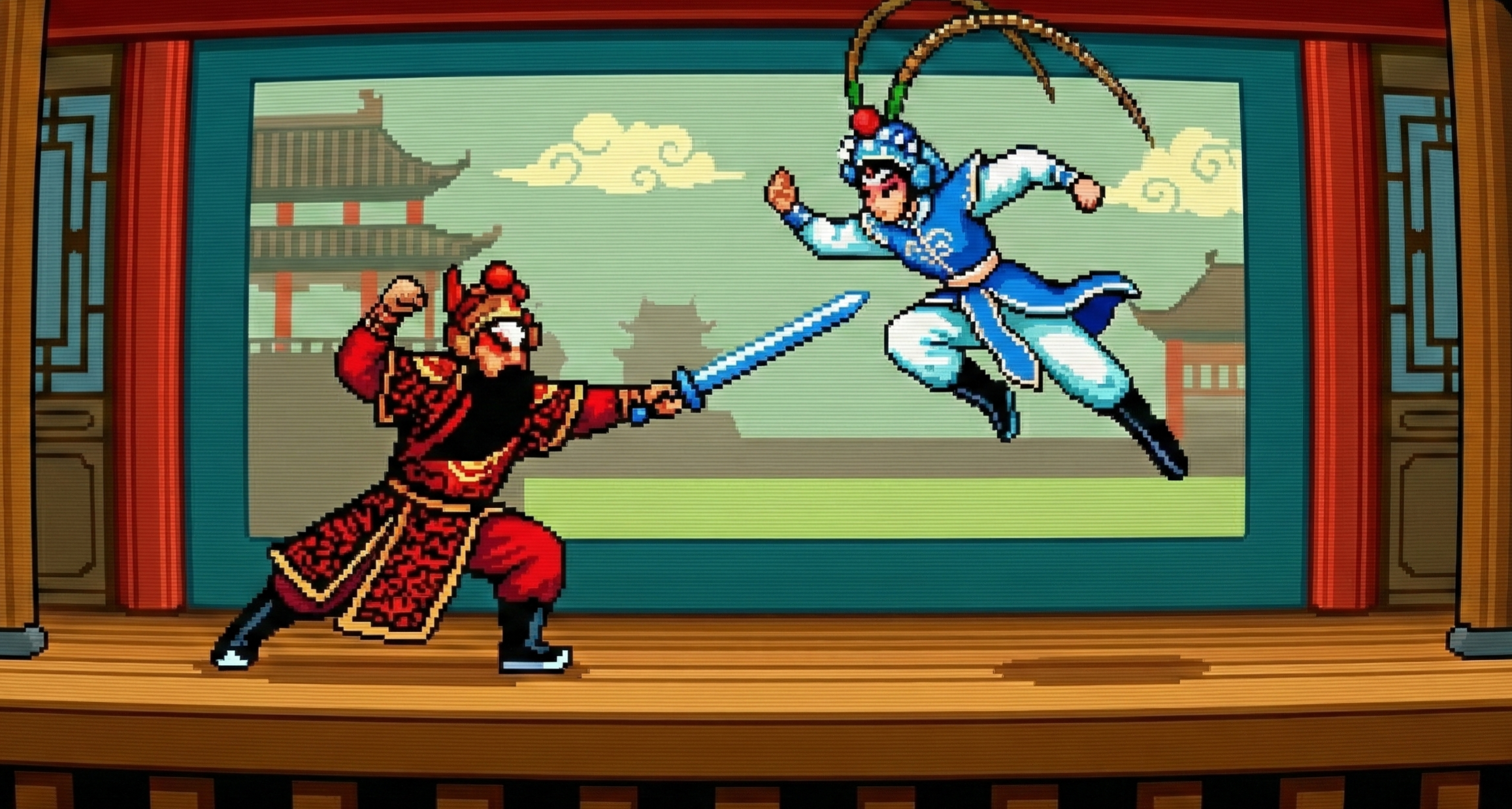
I believe all the Chinese animal and internal martial arts come from mysticism: exorcisms, guilds, healing arts, fortune tellers, festival competitions, etc. To be the most effective mystic required the cooperation of the elements, which you could represent at a theater with the cooperation of costars, creating beautiful shapes and rhythms. I think this is to China’s credit: it’s arguably more advanced than old, live American or Japanese entertainment. Noh and Kabuki theater seemed uninterested in cooperation but were more a theater of clashes. Buffalo Bill’s Wild West shows were the same: reenactments of frontier battles, etc. A closer parallel to Chinese opera would be Laban’s interpretive dance and Montreal’s Cirque du Soleil, which are more collaborative.
In summary, I don’t believe the actual Chinese martial arts (warfare and gang battles) had much direct influence on the theatrical arts. They almost feel like opposites, which again is evidence of advancement. Even the adoption of red as a “lucky” color implies that Chinese mysticism was advanced enough to adopt red as a kind of vaccine or poison-as-cure, while red remained kind of taboo color in America and Japan (as with everywhere in the world). Chinese opera was more influencial in the arts. It was the art of the diaspora after all. But its cooperative nature makes it difficult to implement in most American action cinema. The exception is when America needs complex expression, as in the late 90s. This is why I call The Matrix “Silicon Valley Wuxia”. It’s also why I think Bourne was the more natural “warfare” style after 9/11.
The last thing I’ll say is that I think Chinese Opera thrived because of the lack of firearms in China, which weren’t issued until late Qing. The arts that developed under the threat of iron warfare are very different from arts developing under gunpowder. Now that we’re at the nuclear level, firearm combat is “thriving” with John Wick, Call of Duty, etc., but these are still uncooperative forms. I hope a new kind of symbolic opera can take hold and we can experiment with cooperative movement again. It felt like Ong Bak did this in a beautiful way, taking Muay Thai and giving it a new lore. The Wick style has gone so far that even comedies are using it (guy enters room, looks for stuff that he can use to kill people with, audience winces). What do we call this? Kill-core? I assume people enjoy kill-core for the same reasons they enjoy horror: the anticipation of the violence, the shock of the hit, and the cooldown which produces a cathartic laugh. But I find that kill-core lends to cheaper humor that’s more a product of intensity than intelligence. Kill-core is only one method in a million to approach a combat scenario. The wise artist will find many other means to solve the problem and produce something deeper than mere catharsis, perhaps a conversion moment for the audience.
It worries me that stunt performers keep falling back on it blindly in their indie projects. More and more of the new stunt performers are ignorant of how the great Hong Kong directors approached conflict. I personally hire more Cirque performers now than stunt performers because they see things in more dimensions than stuntmen and women, unfortunately, and until that changes, Hong Kong punch will continue to be a bad fit for American action cinema.