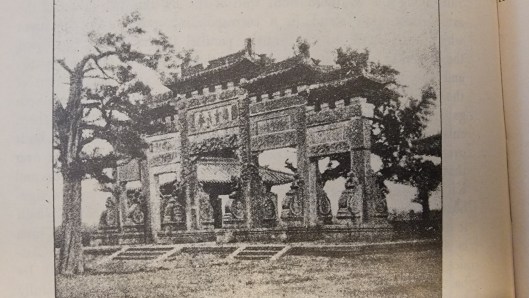
Fortified cities, and the entire social structure, in China might have begun with burial mounds. Whereas there are many mentions in the Li Ji and other documents that concubines, wives, and slaves were killed at the funerals of dignitaries and emperors, the Han Dynasty mostly abolished this. Instead, paper or straw figurines were buried in the place of human victims. The Terracotta Warriors were one such mass sacrificial substitution.
A more common custom was for such people to live at the grave site so that they could make regular offerings to the dead and prevent the spirits from wandering and making a public health crisis (or causing floods, famine, etc.) Soldiers were also stationed at the graves to prevent looting of the grave, where treasures like jade and gold were stored to finance the afterlife of the dead. Fortifications were built to further secure them from robbery.
One grave-robbing gang was called the Vermilion Eyebrows, who ransacked various mausolea, and following this and other thefts, custom shifted to substitute “joss money” for real money, paper goods for real goods, etc.
Many villages appear to have emerged out of the grave sites of notables. One such town was Kong Li Yan. The Domestic Discourses of Confucius, Chapter 9, states that this town grew on the burial mound of Confucius himself:
“All the disciples stayed at the tomb and performed the rites of mourning in their hearts. ..After the three years of mourning were over, two or three of the sons some stayed and some left, but Zigong lived by the tomb for six years. Since then, more than a hundred disciples and people from Lu have lived in the tomb as if it were their home, so they named their residence Kongliyan. – The Domestic Discourses of Confucius, chapter 9, §End Notes.” (For the Chinese text, see image, quoted in De Groot, Religious Systems of China Vol II, 1972 ed., p. 796).


This confirms my hypothesis that cities emerged only when a successful transition was made from matrilocal, intermarrying clans to patrilocal townships that could be defended with bronze and iron weaponry. In China, the consolidation of the empire under Qin (221 BC) marked a pivotal moment when a singular family was able to defend its new kinship structure against the external matrilineal clans. Matrilocal marriage customs dictate that a husband move to his wife’s town, and his inheritance is passed to his sister’s children, located in his home town, meaning he can’t transfer buildings, walls, etc., and therefore has no incentive to build them. Nor did matrilineal warfare necessitate the building of such fortifications, since peace was typically ensured via intermarriage, and raids and headhunting comprised the major episodes of violence.
So, patrilocal marriage, whereby a man brings his wife to his home, and passes his inheritance to his biological sons, who remain in his estate, could incentivize the building of fortified cities. This was incompatible with the matrilocal system. It was a kind of war of operating systems, the matrilocal systems unable to intermarry with the patrilocal one since inheritance transfer would have only benefitted the latter. Without adequate manpower and weaponry, patrilocal cities would (and did) die out.
Therefore, we have to assume that one patrilocal state kicked off the trend in various places. John McLennan in the late 19th century assumed that bridal capture was the founding moment, but I think it’s more likely that the grave mound of a patrilocal ruler was a founding city of a patrilocal system, at least in China. The same pattern can be seen in Rome, Greece, and Israel with the consolidation of the gens, genos, and gentiles respectively into a major city-state, always defended with iron weaponry. The location of David’s grave in Jerusalem is another hint that Jerusalem might have been founded in a similar way.
Leave a Reply