I recently saw a post by Luke Bergis asking what kind of technology is good:
My answer goes back to the ROBA Hypothesis: if we’re hoping to create non-violent technologies that are good for the soul, then we need to reevaluate our biases about violence and stop calling it “apelike” or “inhuman.” We need to call it what it is: completely human and ever-present.
Language serves to differentiate terms so that we can defer violence, but the act requires constant energy. A purely linguistic example is the Chinese terms “to buy” (买 Mǎi) and “to sell” (卖 Mài). They’re almost the same, but have opposite meanings. We might assume that, at their core, there is one original “Mai” which simply means “exchange” and this is only differentiated through constant linguistic effort. Writing helps to ensure these never devolve into their root word again.
Another example is the weird English word “cleave” which means both “attach” and “separate.” Presumably, its root is the act of inserting something into another thing (e.g. a shim into the top of a handle inserted into the head of a hammer), making a new thing that’s both united and separated at the same time. We have simply stopped using the term to denote “attach,” which might be the result of our tendency to use that same cleaver to just cut a lot of things down. (Though, we still cite the Genesis command that a man shall “cleave” to his wife, something which always makes the reader do a double-take.)
Technologies have the power to externalize this differentiation so that we don’t have to maintain this differentiation in language. E.g. dancing and musical instruments are the same in the Maori Hakka dance (the slapping of the body as a drum). By creating a drum, a culture can permanently differentiate dancing from drumming, in effect outsourcing the drumming to other godlike entities (masked drummers, etc.). Therefore the drum is always a sacred instrument. In modern European artwork, the drum is further separated from the sacred: in fact it is almost non-existent in European religious music.
I would assume that one of the first acts of fabrication or carpentry – the knapping of the “handaxe” – was not actually for utility at all. Rocks were everywhere and useful as weapons for people (unlike with animals, which do not use them as weapons in combat, even though they might be apt with tools). The use of rocks as weapons might have itself been a language. A pile of rocks atop a dead body was itself a warning (stoning a person to death), blessing (a cairn), temple (a pyramid), landmark (the Roman boundary stone which had its own sacred properties). By actively chipping a rock into an aesthetic shape so it is un-wieldable (as an Acheulean handaxe has no section allowing a user to grab hold of it), Oldowan and Acheulean technology separated rocks from language. The “handaxe” is not really a handaxe by this scheme. It actually means “don’t use me for killing”. Of course it can be co-opted for killing later by being inserted into a handle, a much more advanced level of technology, but in this case it would have been a warping or misunderstanding of its original intent.
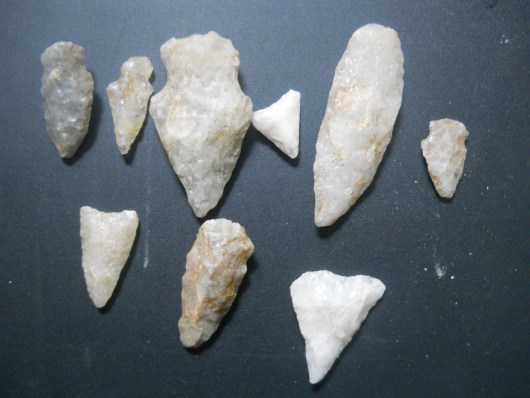
(I often wonder if arrowheads began as misunderstandings. They might have littered the landscape of paleolithic North America, originally made as tokens of exchange in kinship which deferred violence. Jared Diamond reported that they were discovered in Australia, but only in North America were they used as arrows. Either the Native Americans misunderstood their original intention and Australian Aborigines simply chose not to make arrows, or the Native Americans realized a new innovation which simply didn’t occur to the Australian Aborigines.)
Both the chipping of stone to defer violence and the anchoring of that same cut stone onto a haft to make a hatchet (or arrow) for hunting or killing centuries later are technological acts. Both acts serve to differentiate: the first act of mere chipping separated violence from the sacred, the second separated the sacred from organized warfare. Perhaps the Deuteronomic law that required the Jerusalem Temple altar be made from uncut stones was an attempt to recall (and literally enshrine) a time when violence and the sacred were one and the same, but it would only exist in that form at the temple. Otherwise, Israelites were free to cut stone with iron however they wanted.
I can’t pretend to know how to make “good” technology. All of it can be co-opted for murder and genocide. AI, space rockets, and Dyson spheres will all be great and terrible at the same time. But I would simply say that we need to always remember that, at its core, violence is bound up with everything else human, and its through our constant effort that it is separated and held at bay. We need to get past this idea that violence is just some hormone or ape-like tendency: violence is just as human as the Mars Rover. We ignore this at our peril. I talk about this at length in my new book If These Fists Could Talk: A Stuntman’s Unflinching Take on Violence, which you can find on Amazon here: https://a.co/d/9Vhz1wS. (Also check out the OP @lukeburgis’ book Wanting, one of the best Girardian books out there.)
(Header image attribution: Old Time Music Fan at English Wikipedia, licensed under the Creative Commons Attribution-Share Alike 3.0 Unported license.)